Posts

Showing posts matching the search for process validation

Methodology of process validation

Image
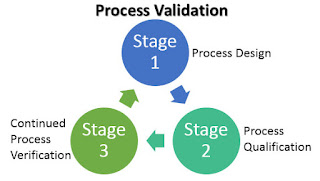
Process validation may be sub-categories into three phases: 1. process design 2. process qualification 3. Continuous process verification Fig: Cycle of process validation

Methodology of process validation

Image
Process validation may be sub-categories into three phases: 1. process design 2. process qualification 3. Continuous process verification Fig: Cycle of process validation

Validation

Image
Definition of Validation  according to (FDA Guidelines 1987): "Establishing the documented evidence which provides a high degree of assurance that a specific process will consistently produce a product of predetermined specifications and quality attributes.” Definition of Validation according to according to (FDA Guidelines, 2011): “Process validation is defined as the collection & evaluation of data, from the process design stage through commercial production, which establishes scientific evidence that process is capable of consistently delivering quality product.” Definition of Validation according to according to (EU GMP 1997): “Action of proving, in accordance with the principles of Good Manufacturing Practice (GMP), that any procedure, process, equipment, material, activity or system actually leads to expected results.” Benefits of Validation: Validation can reduce costs by reducing, Rejects Reworks Relianc...
Common Technical Data for Dossier Preparation I Export Documents Checklist

Full registration dossier consists of 5 modules: 1. Module 1: ADMINISTRATIVE INFORMATION 1.1 Table of contents. 1.2. Application form. 1.3. Summary of product characteristics, labelling and instructions for medical use: 1.3.1. Summary of product characteristics. 1.3.2. Labelling. 1.3.3. Instructions for medical use. 1.3.4. Mock-ups and specimens. 1.3.5. Summary of product characteristics already approved in the manufacturer/applicant-country. 1.4. Information about the independent experts: 1.4.1. Information about the quality expert. 1.4.2. Information about the pre-clinical expert. 1.4.3. Information about clinical expert. 1.5 Specific requirements for different types of applications. Annex to Module 1. Environmental risk assessment MODULE 2: CTD SUMMARY 2.1. Table of contents of Modules 2 – 5. 2.2. Introduction. 2.3. Quality overall summary. 2.4. Pre-clinical overview: 2.5. Clinical overview 2.6. Pre-clinical summary 2.6.1. Pharmacology written summary....

Common Technical Data for Dossier Preparation I Export Documents Checklist

Full registration dossier consists of 5 modules: 1. Module 1: ADMINISTRATIVE INFORMATION 1.1 Table of contents. 1.2. Application form. 1.3. Summary of product characteristics, labeling and instructions for medical use: 1.3.1. Summary of product characteristics. 1.3.2. Labeling. 1.3.3. Instructions for medical use. 1.3.4. Mock-ups and specimens. 1.3.5. Summary of product characteristics already approved in the manufacturer/applicant-country. 1.4. Information about the independent experts: 1.4.1. Information about the quality expert. 1.4.2. Information about the pre-clinical expert. 1.4.3. Information about  the  clinical  expert. 1.5 Specific requirements for different types of applications. Annex to Module 1. Environmental risk assessment MODULE 2: CTD SUMMARY 2.1. Table of contents of Modules 2 – 5. 2.2. Introduction. 2.3. Quality overall summary. 2.4. Pre-clinical overview: 2.5. Clinical overview 2.6. Pre-clinical summary 2.6.1. Pharmacology ...

Process qualification during compression stage ׀ Process validation sampling protocol during compression

Image
Process validation sampling plan during compression: Fig: Sampling during process validation

Effective sampling during process validation ׀ Process qualification sampling plan

Image
Sampling procedure during process validation : For qualification of a process sampling stages & locations are critical parameters. Actually, effective sampling is ultimate part of process validation. During validation of a wet granulation drug product, following stages as well as locations must be consider to qualify the process. At granulation phase, sample should be collected as follow- Premixing Wet mixing Dry mixing 

Blending | Effective Sampling During Process Validation | Optimize Sampling Location

Image
Important of sampling during blending: Sampling plays a great role in achieving the accurate results of analysis. Sampling must and procedure must be defined in validation protocols and training should be provided to the concerned staff before the validation activities start. Samples are representative of the whole batch. So it should be handled and weight carefully because segregation may occur during weighing and transpiration. Sample quantity should not be more than the required and whole mass sample should be used in the analysis. Fig: Blending Machine Sampling for blend: Blends are tested for their homogeneity. Homogeneity of the blend is critical for the quality of the final product. The sample should be taken from at least 10 locations in the blender. The sampling location should be selected according to the difficulty of the blending. Ares of poor blending must be covered in sampling. Corners and discharged point must have...

validation master plan | Scope of validation master plan

Image
The intent of this Validation Master Plan (VMP) is to provide a written plan for establishing documented evidence of the suitability of the facilities, reliability and consistency of the equipment, and validity of the manufacturing process. This VMP shall be used during the design and commissioning of a plant. The VMP is a framework for gathering documentation and conducting qualification studies necessary to fulfill fundamental philosophies of Good Manufacturing Practices in pharmaceutical manufacturing, such as:

Determine sampling interval from a process validation batch during compression

Image
Calculating sampling interval during compression from a process validation batch

Why do we consider three consecutive runs/batches for process validation? Why not two or four?

The number of batches produced in the validation exercise should be sufficient to allow the normal extent of variation and trends to be established and to provide sufficient data for evaluation and reproducibility. ·       First batch quality is accidental (co-incidental), ·       Second batch quality is regular (accidental), ·       Third batch quality is validation (confirmation). In 2 batches we cannot assure the reproducibility of data, 4 batches can be taken but the time and cost are involved.

What is the difference between Calibration and Validation

Calibration is a demonstration that, a particular Instrument or device produces results within specified limits by comparisons with those produced by a reference or traceable standard over an appropriate range of measurements. Whereas Validation is a documented program that provides a high degree of assurance that a specific process, method or system consistently produces a result meeting pre-determined acceptance criteria. In calibration performance of an instrument or device is comparing against a reference standard. But invalidation such reference standard is not using. Calibration ensures that instrument or measuring devices producing accurate results. Whereas validation demonstrates that a process, equipment, method or system produces consistent results (in other words, it ensures that uniforms batches are produced).                     ...

HACCP | The Seven HACCP Principles

About HACCP Hazard Analysis and Critical Control Points (HACCP) is a process control system designed to identify and prevent microbial and other hazards in food production. It includes steps designed to prevent problems before they occur and to correct deviations as soon as they are detected. Such preventive control systems with documentation and verification are widely recognized by scientific authorities and international organizations as the most effective approach available for producing safe food. The Seven HACCP Principles Principle 1 : Conduct a hazard analysis. Plants determine the food safety hazards identify the preventive measures the plant can apply to control these hazards.

Abbreviations frequently applying in pharmaceutical organization

AADA: Abbreviated antibiotic drug application ADE: Adverse drug event ADME: Absorption, distribution, metabolism, and excretion AHU: Air Handling Unit ANDA: Abbreviated new drug application ANVISA: Agencia Nacional de Vigilancia Sanitaria (National Health Surveillance Agency Brazil) AP: Applicants Part (of EDMF) API: Active pharmaceutical ingredient APR: Annual product review (APQR – Annual product quality          Review) AQL: Acceptable quality level AR: Analytical Reagent ASHRAE: American Society of heating, Refrigeration and Air Conditioning Engineers ASM: Active Substance Manufacturer ASMF: Active Substance Master File AST: Accelerated stability testing ASTM: American Society for Testing and Materials BA/BE: Bioavailability/bioequivalence BCS: Biopharmaceutical classification system BET: Bacterial...

Brine Shrimp Lethality Bioassay

Procedure for cytotoxicity  test   Brine Shrimp Lethality Bioassay Introduction Brine shrimp lethality bioassay is the recent development in the bioassay for the bioactive compounds. Natural products (extracts & pure compound) can be tested for their bioactivity by this method Here the simple zoological organism (Brine shrimp nauplii) is used as a convenient monitor for screening & fractionation in the discovery of new biotic natural products. This bioassay indicates toxicity as well as a wide range of pharmacological activities of the compounds. The brine shrimp lethality bioassay has several advantages such as- Rapid in process (24 hours) Inexpensive & simple (e.g. no aseptic technique is required) It easily utilizes a large number of organisms for statistical validation & requires no special equipment 7 relatively small amount of sample is sufficient. It does not require animal serum as it is needed for deter...